
Why documenting matters so much
The Belgian EU-GBV survey shows that 74.1% of male victims of partner violence experience exclusively psychological violence. Belittling, threatening, isolating, controlling: each incident on its own seems "not bad enough", but together they form a pattern of coercive control. It is precisely that pattern you need to be able to make visible.
Documenting also protects you against reversed accusations (DARVO), where your partner presents themselves as the victim — a tactic that often appears around and after separation.
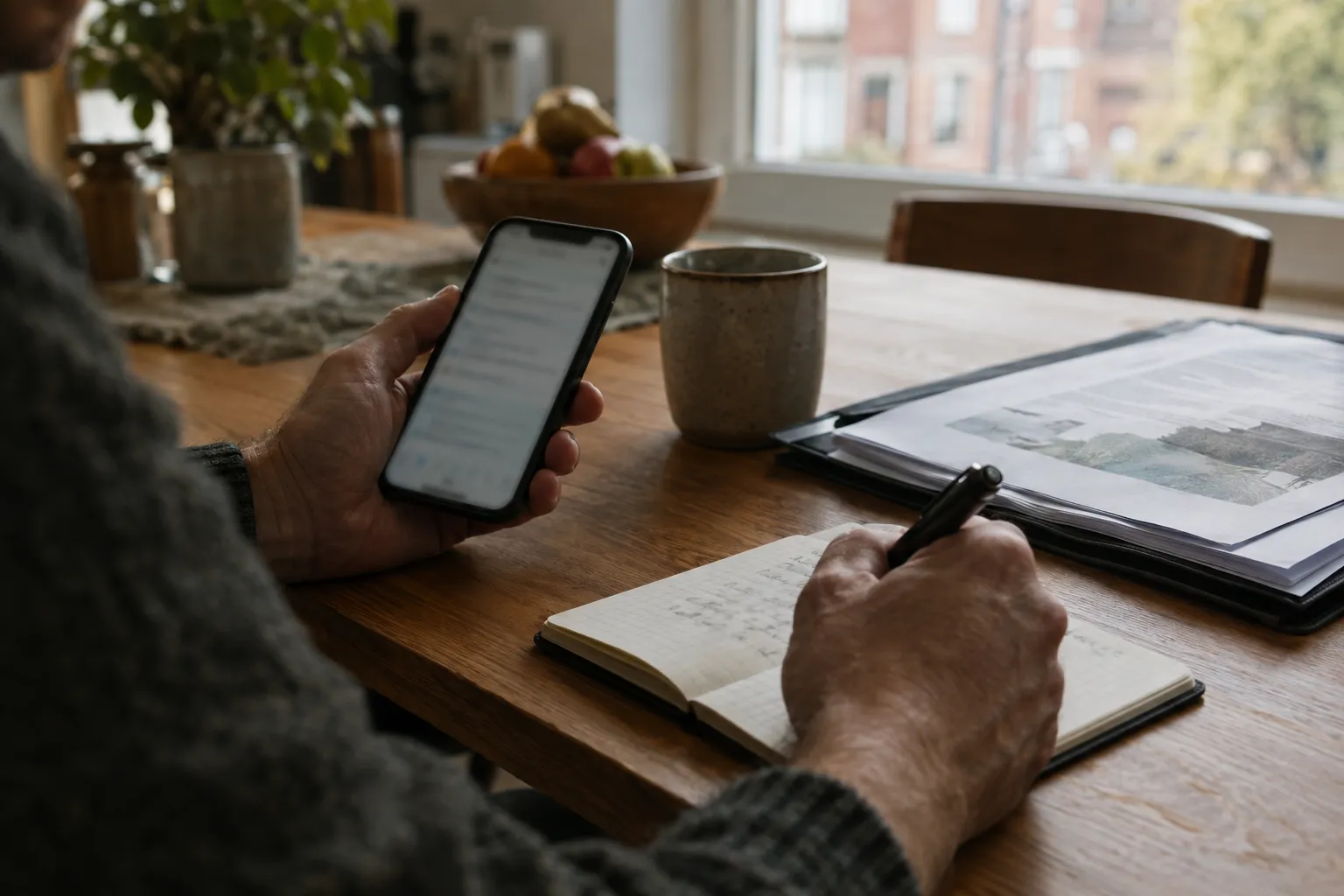
The incident log
For each incident, write down as soon as possible after the facts:
- Date, time and place
- What exactly was said or done — literal quotes work better than summaries
- Who was present or may have heard something (children, neighbours, visitors)
- The impact on you: not sleeping, calling in sick, being afraid to come home
Keep it short and factual; interpretations and reproaches weaken your log. And crucially: keep it out of your partner's reach. Not on a shared computer or tablet, not on paper at home. E-mail each incident to a new, secret e-mail address or to a trusted person — that way every note automatically gets a timestamp. Also read the digital safety tips in the safety plan.
Digital evidence
- Screenshots — with the date, time and sender's name visible in the image
- Export complete conversations (WhatsApp, Messenger, text messages) rather than isolated fragments: context creates credibility
- Keep the originals on your device and back them up to a secure account
- Delete nothing — not even messages that seem unflattering to you
- E-mails: keep them and forward them to your secure address
Medical documentation
See your GP, even if there are no physical injuries. Have your psychological complaints registered: sleep problems, rumination, anxiety, low mood — and describe the context, so it is recorded in your medical file. Several consultations over a longer period will later show the pattern and the impact.
In case of physical injuries, your doctor can draw up a detailed medical certificate: a precise description of the objective findings and your account, possibly with photographs attached. Ask for it explicitly and keep your copy in a safe place.
Witnesses and indirect evidence
- People who saw or heard something: neighbours, family, friends, colleagues — note who knows what
- People you told at the time: their statement confirms that your account was not invented afterwards
- Financial documents: bank statements showing you had no access to money or had to account for everything
Are you allowed to record conversations?
Recording a conversation you take part in yourself is in principle not a criminal offence in Belgium: Article 314bis of the Criminal Code concerns recording communication you do not take part in. Distributing the recording — for example sharing it on social media — can be punishable. So only use recordings for your lawyer, the police or the judge; the judge freely assesses their evidential value.
What counts legally?
In Belgian criminal cases the principle of free evidence applies: the judge freely assesses all lawfully obtained evidence. No single piece has to be conclusive on its own. A log, messages, medical certificates and witnesses reinforce each other — and a demonstrable pattern weighs more heavily than one isolated incident.
Considering a step towards the police? Then read how filing a report works and what to expect. If you feel unsafe while gathering evidence, first check the safety plan or call 1712 — free and anonymous. In immediate danger: see crisis help.
Frequently asked questions
Is a diary or log valid evidence?
Yes, as supporting evidence. In Belgian criminal cases the principle of free evidence applies: the judge freely assesses the evidential value of every lawfully obtained element. A consistently kept, dated and factual log strengthens your credibility, especially combined with messages, medical certificates and witnesses.
How do I prove gaslighting or other psychological abuse?
Not with a single piece of evidence, but with a pattern: an incident log, saved messages and e-mails, medical registration of your complaints and statements from people who saw something or whom you told at the time. Together they make it plausible that this is not a series of isolated conflicts, but a persistent pattern of control.
Am I allowed to look in my partner's phone?
No, do not do that. Accessing someone's phone, e-mail or accounts without permission can be a criminal offence in Belgium as unauthorised access to a computer system (hacking), even within a relationship and even if you know the password. Evidence obtained this way can also work against you and damage your credibility. Document what is being done to you, not what you suspect about your partner.
Am I allowed to record a conversation with my partner?
Yes, in principle: Article 314bis of the Belgian Criminal Code concerns communication you do not take part in. Distributing the recording can be punishable. Only use recordings for your lawyer, the police or the judge, who assesses their evidential value.