Patterns, frequency and context matter
Risk assessment in partner violence requires attention to patterns, frequency and context — not just isolated incidents. Certain moments significantly increase the risk of escalation.
Classic, incident-based assessment often falls short for male victims. A single shove says little; a years-long pattern of humiliation, control and threats says a lot. Two questions quickly reveal that pattern: who is afraid of whom? and who adapts their behavior to avoid escalation? In cases of mutual accusations, these questions usually point toward the real victim.
Why context is so often overlooked: read about context blindness.
When risk increases
Critical moments
- At (announcement of) separation or recent relationship breakdown
- During legal proceedings about children or assets
- When the perpetrator is at risk of losing control
- When there is coercive control as a baseline pattern
Risk-increasing factors
- History of physical violence (even if it seems to have stopped)
- Threats of suicide or murder
- Access to weapons
- Substance use
- Social isolation of the victim
- Previous false reports or legal intimidation
Post-separation risk
- Violence can sometimes escalate right after separation
- Institutional/administrative abuse is a recognized form of post-separation violence
- Instrumentalization of children as a continuing control tactic
Structured instruments
Use a structured instrument as a checklist alongside your professional judgment — not as an arithmetic exercise:
- B-SAFER (Brief Spousal Assault Form for the Evaluation of Risk): a short, structured checklist for partner violence risk, usable in primary care and by police.
- HCR-20 with FAM (Female Additional Manual, co-developed by Dr Vivienne de Vogel): complementary guidelines for risk assessment with female perpetrators.
Important caveat: most instruments were validated in populations with female victims and male perpetrators. Scores for male victims may underestimate the risk — especially when the violence is mainly psychological. Use the item list to guide your conversation and document your reasoning.
Case: pattern versus incident
Fictional example. A 42-year-old man consults you about insomnia and headaches. Only on further questioning does he tell you that his partner manages his bank card, reads his messages and threatens to "take the children away" if he mentions separation. Once, she threw a glass at his head. If you only record that glass, the file looks like a one-off incident. If you record the pattern — financial control, digital control, threats involving the children, recent separation plans — four risk factors appear that require follow-up.
Documentation principles
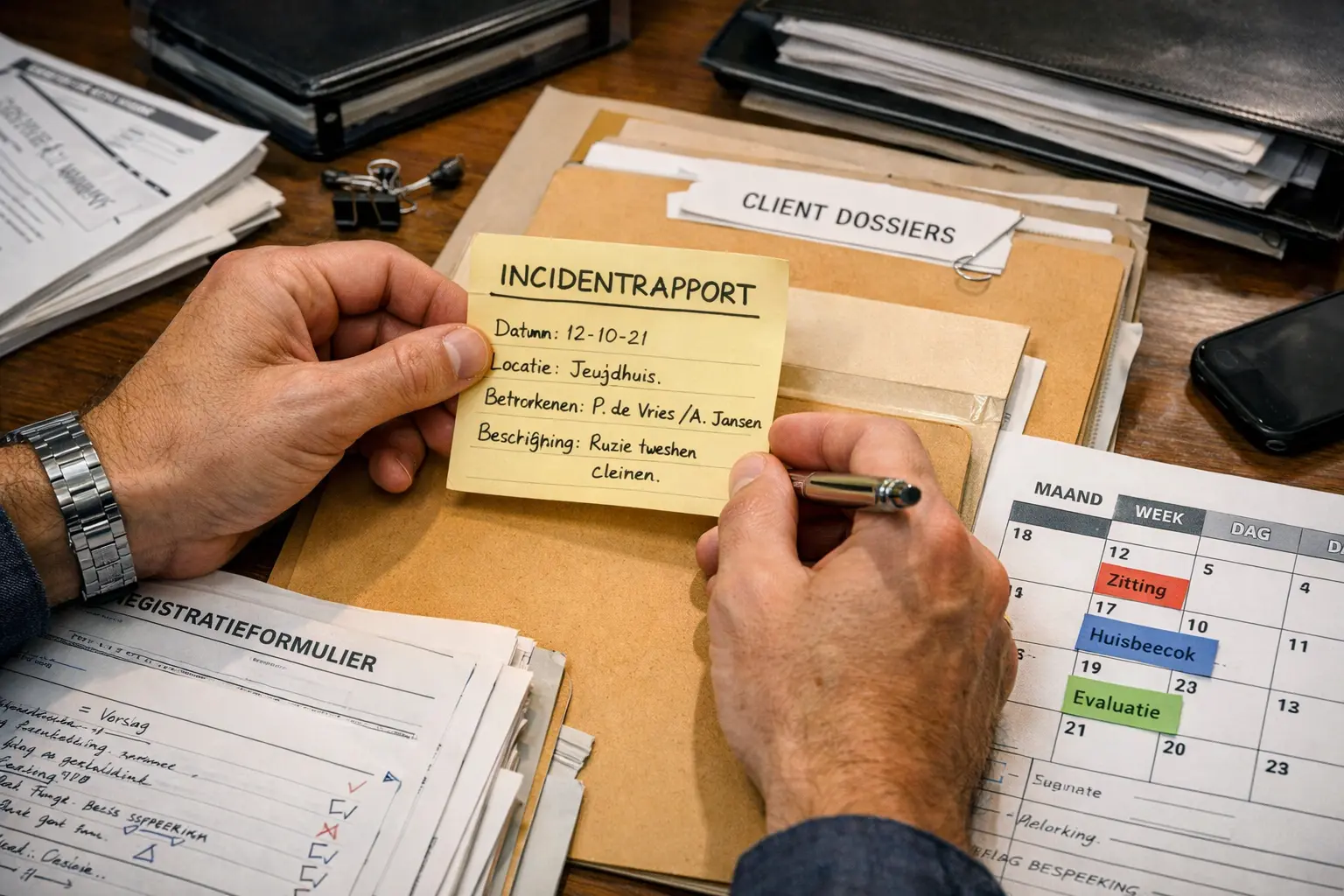
- Describe behavior objectively (what, when, who was present, impact)
- Map patterns over time — isolated incidents disappear in a legal file
- Include digital and administrative components (tracking, false reports)
- Note impact on children separately
Temporary exclusion order
In Belgium, in cases of serious and immediate danger, a temporary exclusion order can be requested:
- Initial duration: maximum 14 days (imposed by the public prosecutor)
- The family court can extend it by up to 3 months
- Request via the police or public prosecutor
- Follow-up by a justice house
Temporary exclusion order — Vlaanderen.be
Chain approach
For complex cases, involve:
- Police and public prosecutor
- CAW
- Justice house
- Childcare or school (if children are involved)
- GP or psychiatrist
Frequently asked questions
What is risk assessment in partner violence?
Risk assessment is the systematic estimation of danger for a victim, based on the pattern, frequency and context of the violence. It helps professionals set priorities and choose appropriate interventions.
When does the risk increase in partner violence?
Risk increases with growing frequency or severity of incidents, at or after separation (post-separation risk), access to weapons, prior use of physical violence, and suicidal or homicidal statements.
What are the documentation principles in risk assessment?
Document concrete facts (date, behaviour, context), avoid interpretations, and keep documentation secure and confidential. Good documentation supports the assistance provided and any legal proceedings.
What is a temporary exclusion order and when is it used?
A temporary exclusion order requires the perpetrator to leave the home for a set period. It is used when there is immediate danger to the victim and further escalation must be prevented.