
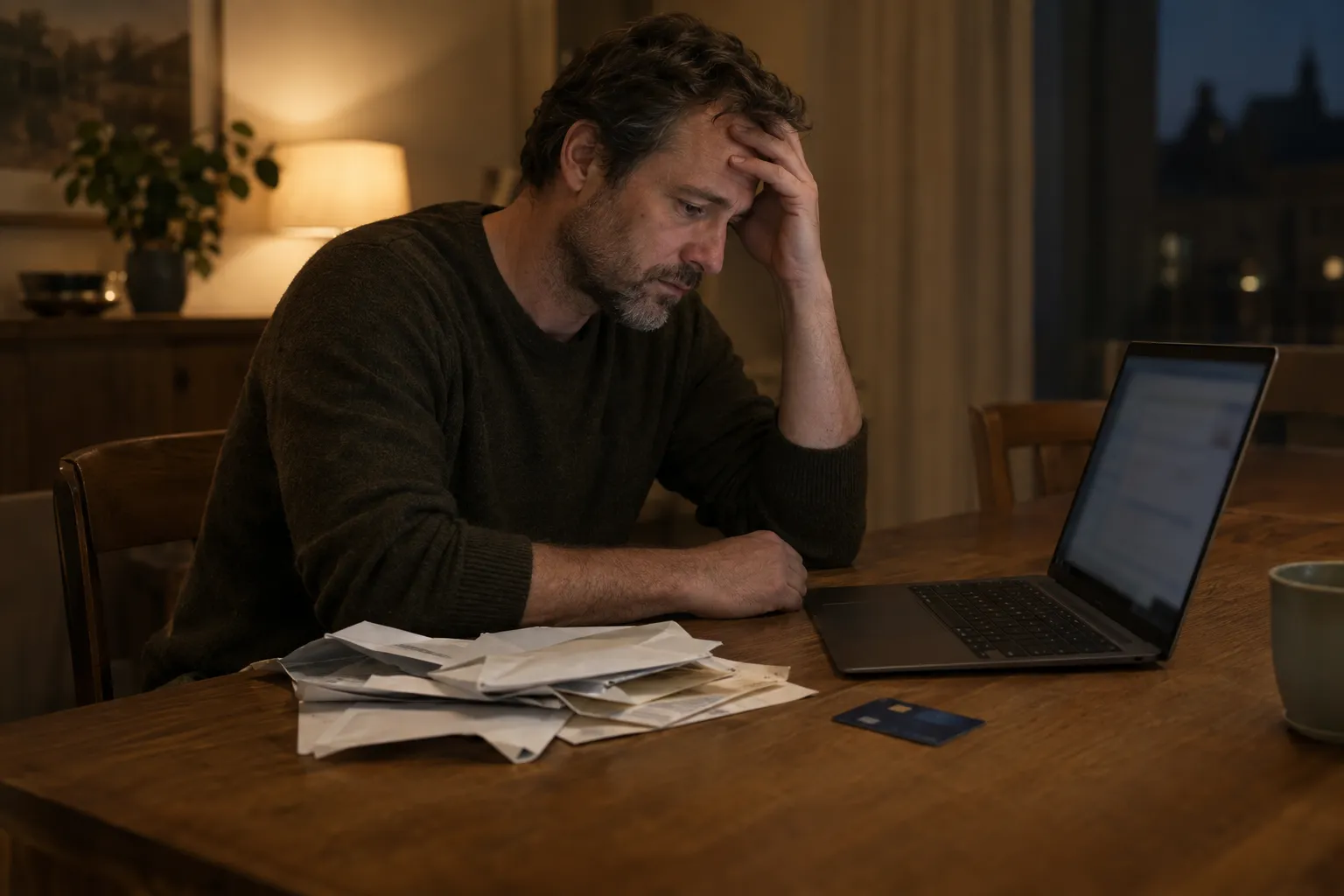
What is financial abuse?
In financial or economic abuse, your partner uses money and possessions to exert power over you. She manages what comes in and what goes out — and step by step you lose your financial independence.
It can look like this: you have to hand over your wages, you have no access to the accounts, you receive "pocket money" out of your own income, debts are taken on in your name, your work is sabotaged or forbidden, or financial information is deliberately kept from you.
Financial abuse is one of the least recognised forms of partner violence — including by victims themselves. And it is one of the main reasons why leaving fails: without money of your own there is no rental deposit, no lawyer and no buffer for the first months alone.
Do you recognise this?
- You hand over your wages (in part) and get "pocket money" back out of them
- You have no bank card, no codes or no access to the online banking of the joint account
- You have to justify every expense, down to the receipts — the reverse does not apply
- Loans, credit lines or instalment purchases are running in your name that you did not really choose
- Your partner discourages, sabotages or forbids your work — or pushes you towards more hours while she manages the money
- You do not know what is in the accounts; mail and financial documents are kept from you
- Big decisions (a loan, a purchase, a guarantee) are made without consulting you, yet still in your name too
Do you recognise several points? Take the self-assessment or read how to recognise the other signs.
Why it is extra invisible in men
"But he earns his own money" — the breadwinner norm makes financial abuse of men almost unthinkable. Yet a wage of your own is no protection: whoever has to hand over his income, or has no access to the account it is paid into, is left just as penniless as someone who earns nothing.
Many men also justify it themselves: "she is simply better with money." Why that mechanism works this way, you can read on why you justify it. And the step towards the outside world is rare: the Belgian EU-GBV survey shows that only 3% of male victims of partner violence report it to the police.
First steps towards financial breathing room
- Open a current account of your own. You do not need your partner's permission — see the frequently asked questions below for how to do this discreetly.
- Have your wages paid into that account. Changing your account number takes a simple message to your employer or HR department.
- Secure important documents — identity card, payslips, contracts, statements. How to do that is in the safety plan.
- Check which credits are registered in your name. You can do that free of charge at the Central Individual Credit Register of the National Bank, online with your Belgian eID or itsme.
- Talk about it. 1712 is free, anonymous and does not appear on your phone bill.
Debts in your name
Debts are often the longest-lasting trace of financial abuse. You do not have to untangle them alone:
- Debt mediation is free at a recognised service — almost every OCMW/CPAS (public social welfare centre) and every CAW is recognised. A debt mediator examines which debts are really yours and negotiates a feasible repayment plan with creditors.
- Budget guidance (you manage your budget yourself, with advice and support) and budget management (the service temporarily manages your income) are also free via the OCMW/CPAS or the CAW: 0800 13 500.
Are you married? Then debts your wife took on for the household or the children's upbringing also bind you jointly and severally (Article 222 of the old Belgian Civil Code); this applies to all married couples, regardless of the marriage contract. Important nuance: you are not jointly liable for debts that are excessive in view of the family's means. Always have your specific situation assessed by a debt mediator or lawyer.
Document for later
Keep or photograph account statements, loan contracts, payslips and proof of handed-over wages or "pocket money", and store them somewhere your partner cannot reach. In a separation or court procedure this makes the difference — read more about gathering evidence. Bear in mind that financial control can also continue after separation, for example through court proceedings or refused settlements.
Feeling unsafe? See crisis help or call 1712.
Frequently asked questions
My partner manages all our money — is that abuse?
Not necessarily. In many relationships one partner manages the budget, and that can be a healthy division of tasks. It becomes abuse when you no longer have insight or access, have to justify every expense or receive "pocket money" out of your own income. The criterion is not who pays the bills, but whether you can still freely dispose of money.
Am I liable for debts my partner made?
That depends on your situation and the type of debt. If you are married, debts taken on for the household or the children's upbringing bind both spouses jointly and severally (Article 222 of the old Belgian Civil Code), except when they are excessive in view of the family's means. Have your situation assessed free of charge by a recognised debt mediator at the OCMW/CPAS (public social welfare centre) or the CAW.
How do I discreetly open my own bank account?
You do not need your partner's permission to open a current account in your own name. Consider a bank where you are not yet customers, ask for digital account statements instead of paper mail and use an email address and codes only you know. Then have your wages paid into that account via your employer.
Where can I find free help with debts?
At a recognised debt mediation service: almost every OCMW/CPAS (public social welfare centre) and every CAW is recognised. Debt mediation, budget guidance and budget management are free there. You can reach the CAW on 0800 13 500; you will find your local OCMW/CPAS via your municipality's website.